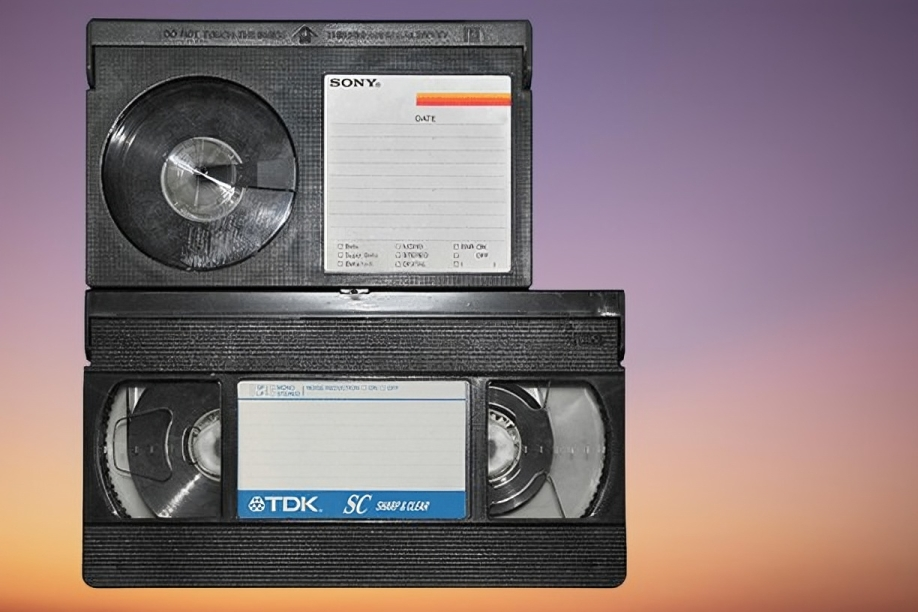
What’s the quick answer to why Betamax failed?
- Betamax lost because consumer convenience, recording time, and licensing openness mattered more than picture quality.
- By 1987, VHS controlled over 90% of the home video market.
The gaps in licensing, content availability, consumer marketing, and timing proved powerful in the VHS vs Betamax comparison. Even though many still ask Was Betamax better than VHS?, in the market, it didn’t matter enough to win.
What was the Betamax vs VHS rivalry in the 1980s?
In the late 1970s and throughout the 1980s, consumers and electronics companies found themselves in a fierce battle over which home video recorder standard to use. The Betamax tape vs VHS comparison was everywhere.
Sony’s Betamax (Beta) was introduced in 1975, and shortly afterward, JVC launched its VHS (Video Home System) in 1976.
The rivalry became a format war. Manufacturers, content owners, retailers, and consumers all had stakes in the VHS vs Betamax duel to see which brand would become the dominant standard for home video.
In many video rental stores, customers would sometimes ask, “Beta or VHS?”, a question that summarized the clash in the market.
Over time, VHS took over, and today Betamax is mostly a footnote in tech history. But that doesn’t mean its story is without lessons.
| Year |
Event |
Key Impact |
| 1975 |
Sony releases Betamax |
Compact design, 1-hour recording |
| 1976 |
JVC launches VHS |
Open licensing, 2-hour recording |
| 1977–1983 |
Format war peaks |
VHS gains content & partners |
| 1987 |
VHS dominates 90%+ of the U.S. market |
Betamax marginalized |
| 2002 |
Sony stops Betamax production |
VHS becomes a de facto standard |
How did Betamax and VHS formats originate?
Let’s trace how both formats came to be:
- Betamax (Sony)
Sony introduced Betamax in May 1975. The idea was to bring a high-quality and compact video cassette system to the market. It followed from Sony’s experience with earlier video formats, notably U-matic. The earliest design of Betamax allowed about one hour of recording time in the βI mode.
- VHS (JVC / Matsushita / consortium)
JVC, along with parent and allied companies like Matsushita, introduced VHS in 1976. A key strategic decision was to license the VHS widely so that many electronics makers could produce VHS-compatible hardware. From its start, VHS could record for long, which made it more attractive for full-length movies and television.
Sony’s closed approach vs JVC’s openness would prove central to the larger VHS vs Betamax comparison.
What were the key technical differences between Betamax and VHS?
While many of the differences were subtle, they did influence consumer perception and product performance. Below is a breakdown of technical and practical differences:
| Feature |
Betamax |
VHS |
| Tape Width & Cassette Size |
Uses ½-inch tape in a relatively compact cassette. |
Also, ½-inch tape, but the cassette and tape-handling allowed more tape length. |
| Recording Time (Original Modes) |
~1 hour in βI mode. |
~2 hours in the standard play mode. |
| Extended Modes |
Sony later introduced βII and βIII to extend recording time, at the cost of reduced resolution. |
VHS added EP/SLP and HQ modes to stretch time and improve quality. |
| Image & Signal Quality |
Slightly better signal-to-noise, less crosstalk, better control of tape mechanics |
Over time, VHS improved, e.g., VHS HQ, and narrowed the quality gap. |
| Tape Transport & Complexity |
More complex tape mechanics, more precision parts |
Simpler transport design meant cheaper manufacturing, faster rewinding/fast-forwarding |
| Licensing/ Manufacture |
Initially closed. Sony restricted who could make Betamax equipment |
VHS was broadly licensed to other manufacturers, increasing competition and market penetration |
| Content & Format Support |
Fewer films and prerecorded tapes in the Betamax format early on |
More studio and rental support for VHS, making it more attractive to consumers |
Was Betamax better than VHS?
Technically, yes, in some respects. However, the differences weren’t enough in practice to offset the advantages of VHS in time, availability, and scale.
Why did Betamax lose to VHS despite having better quality?
This is the heart of the question — Why did Betamax fail? There were multiple interlocking reasons, and many lessons about technology adoption emerge from this case.
1. Recording time was king
Most consumers wanted to record a full-length movie or a standard TV program without switching tapes mid-way. VHS offered ~2 hours in its early SP mode, while Betamax was limited to ~1 hour.
Sony eventually responded with extended modes like βII and βIII, but by then, VHS had moved ahead and optimized its modes too.
One industry historian put it succinctly:
“Betamax had owned the market, but lost it because Sony got one simple decision wrong. It chose to make smaller, neater tapes that lasted for an hour, whereas the VHS manufacturers used basically the same technology with a bulkier tape that lasted two hours.”
2. Licensing strategy and partner support
Sony insisted on keeping control of the Betamax standard. They were reluctant or slow to widely license the technology to other manufacturers.
In contrast, JVC and its partners licensed VHS broadly, spurring many manufacturers to produce VHS machines at competitive prices.
This licensing openness created a much wider ecosystem of VHS devices, accessories, and lower pricing.
Myth: VHS won only due to adult content.
Reality: That niche helped early adoption, but open licensing and recording length were decisive.
3. Price and economies of scale
Because many companies produced VHS hardware and tapes, the costs dropped. VHS got cheaper faster. Betamax, with fewer licensees and stricter controls, couldn’t match that scale easily.
Lower costs and more competition helped VHS dominate in terms of value-per-dollar.
4. Content availability & format preference
Movie studios and rental businesses leaned into VHS because of its scale and easier distribution. More titles were released on VHS, which further attracted consumers.
Moreover, some claim that certain studios refused to release adult content on Betamax, giving VHS an edge in that market niche, though this is debated.
5. Timing and market psychology
Even though Betamax had a head start, arriving a year before VHS, Sony’s slow adjustments and conservative approach allowed VHS to catch up quickly.
Consumers often hesitate if a format feels “less supported,” and those hesitations gravitated toward VHS’s momentum. As VHS machines and tapes proliferated, more people adopted VHS, reinforcing its dominance.
6. Technical compromises diluted Betamax’s advantage
To match VHS in recording time, Sony had to slow down tape speeds and reduce resolution in extended modes. This undermined some of the image quality benefits that Betamax initially claimed.
Thus, even though many ask, “Was Betamax really better quality than VHS?” — yes, in theory, but the real-world value to average consumers was marginalized by other advantages of VHS.
Facts That Defined the Format War
1. “By 1984, over 50% of American homes owned a VCR, 70% of which were VHS.”
- In a 1998 report titled “Prerecorded Home Video and the Distribution of Theatrical Feature Films”, David Waterman states that by early 1984, about 70% percent of U.S. households had a VHS, which was just at 55% in 1979.
2. “At its peak, VHS held more than 90 % global or U.S. market share.”
- A Time article states: “By 1987, VHS accounted for more than 90% of the $5.25 billion worth of VCRs sold in the U.S.”
3. “Betamax sold fewer than 20 million units worldwide before being discontinued in 2002.”
Did You Know? Sony didn’t end Betamax tape production until 2016, which is over 40 years after its debut!
What legacy did the Betamax tape vs VHS format war leave behind?
Though Betamax lost, the Betamax vs VHS format war left several lasting lessons and industry patterns:
1. Standard wars in consumer electronics
The format war between Betamax and VHS became a classic case study in how better technology doesn’t always win, and market dynamics, licensing, partner support, and user convenience often decide victory more than specs.
Later format conflicts, like HD DVD vs Blu-ray or VHS vs DVD, echoed many of the same tensions.
2. Reminder that market adoption involves economics, not just engineering
The story illustrates that the “best” technical solution must also align with price structures, licensing models, and consumer demands.
3. Formats evolve and hybridize
Even as Betamax faded, parts of its lineage lived on in professional video formats such as Betacam. Meanwhile, VHS continued for decades, evolving through HQ and S-VHS modes and eventually coexisting with emerging digital video technologies.
4. The importance of preservation and digitization
As obsolete analog formats like Betamax, VHS, 8mm tapes, etc., age, preserving their content becomes urgent. Many individuals and archives now use video tape to digital conversion services to prevent content loss.
That transformation from physical analog to digital is part of the modern legacy of videotape media.
If you have existing collections, now is a good time to explore options. For example, Smooth Photo Scanning helps convert and preserve those tapes for future access.
What Do People Today Say About Betamax vs VHS?
The debate still lives on Reddit threads and nostalgia forums. Here’s what users say:
- From r/80s: “Betamax had better video quality, but VHS won on volume.”
- On r/nostalgia: “Beta had better quality but was more expensive. VHS was cheaper and ran longer.”
- From r/AskHistorians: “Consumers wanted longer recording time and affordability, not higher fidelity.”
Together, these modern voices confirm that VHS met consumer needs better, even if Betamax was technically superior.
What lessons can we learn from the Betamax vs VHS rivalry?
From the Betamax vs VHS story, several takeaways stand out:
- Consumer convenience often outweighs superior specs
People wanted longer recording times and more content choices, not marginal gains in image quality.
- Open licensing and ecosystem support are crucial
A broader manufacturer base improves affordability, availability, and scale.
- First-mover advantage is fragile
Even though Betamax was first to market, its hesitation and strategic missteps allowed VHS to dominate.
- Technology must adapt to market needs quickly
Attempting to force a perfect design may delay product iterations and allow competitors to catch up.
- Preserve legacy media while you can
The physical media of previous decades degrade. Early digitization is key to retaining content.
If you’re dealing with old videotapes, VHS, or Betamax, there’s value in converting them before it’s too late.
Preserving your media is increasingly important, regardless of whether you use VHS to DVD converter hardware or find a photo digitizing service that handles videotape content.