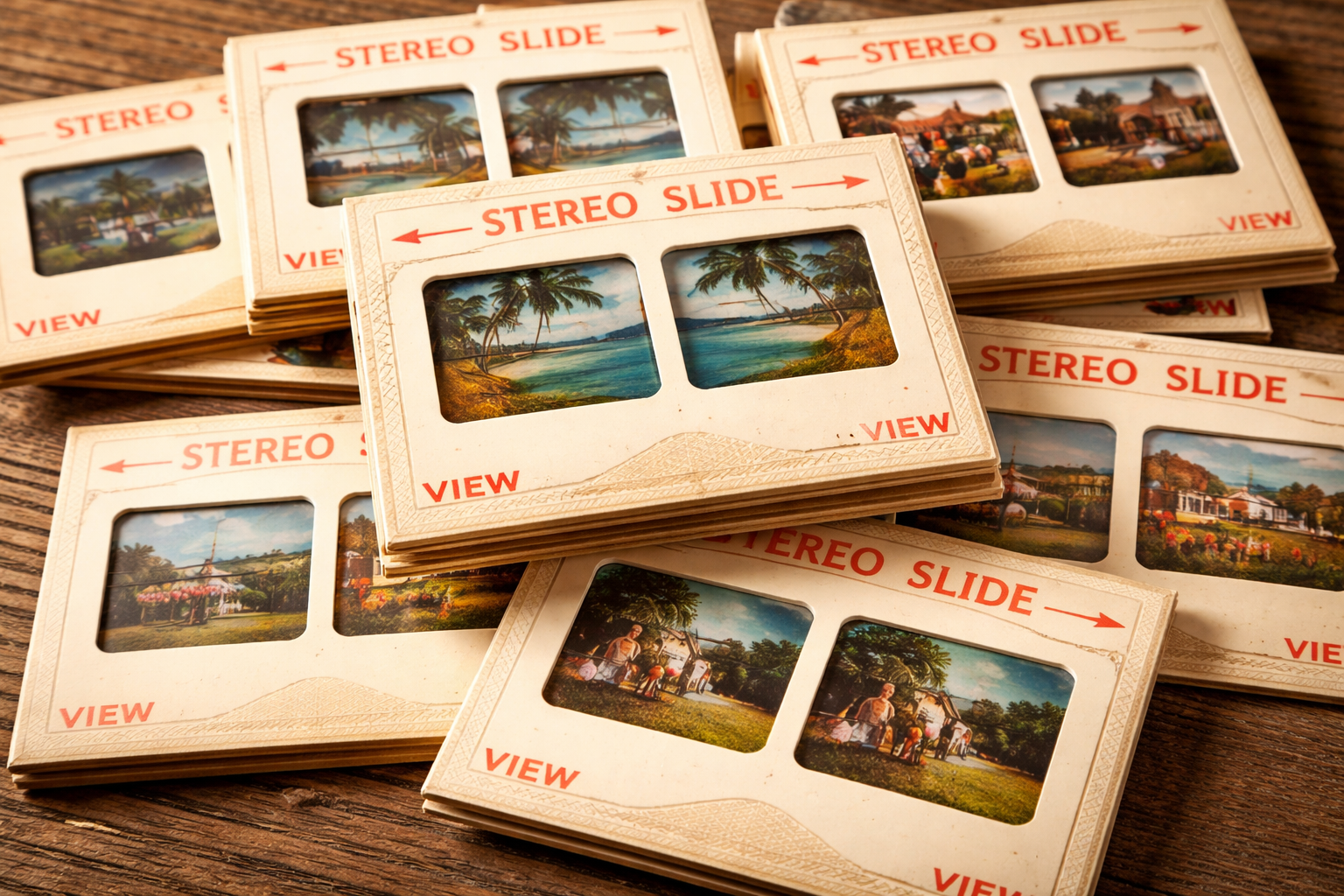
Vintage stereo slides are historical artifacts that capture depth, perspective, and moments in time that often exist nowhere else. Popularized in the late 1940s and 1950s, these slides were designed to be viewed through stereoscopes, creating a three-dimensional illusion from two nearly identical images placed side by side.
Today, many families and collectors want to preserve these memories digitally. However, vintage stereo slide digitization presents unique challenges that standard photo scanning does not.
Aging film stock, delicate mounts, and accumulated dust make improper handling risky. Choosing the safest way to scan stereo slides is essential to avoid irreversible damage.
Today, we will delve into the options to digitalise stereo slides, explain proven safe slide scanning methods, and outline what to look for when preserving these fragile originals.
What Are The Challenges in Stereo Slides Preservation?
Unlike single-frame 35mm slides, stereo slides contain two exposures of the same scene mounted side by side. When viewed through a stereoscope, the human brain fuses these images to create depth.
Key differences include:
- Two nearly identical frames in one mount.
- Greater sensitivity to alignment and cropping.
- Often thicker or non-standard mounts.
- Designed for optical viewing, not flat reproduction.
These characteristics mean vintage stereo slide digitization requires specialized handling. Feeding stereo slides into equipment designed for standard slides can stress mounts or misalign images, compromising both safety and image quality.
What Are The Common Risks When Digitizing Vintage Stereo Slides?
Without proper precautions, digitization can permanently harm original slides. Primary risks include:
- Mechanical stress from automatic slide feeders.
- Surface abrasion from improper cleaning.
- Dust embedding when compressed air is misused.
- Heat exposure from consumer-grade scanners.
Myth Busted:
“All slide scanners can handle stereo slides.”
In reality, most consumer scanners are not designed for stereo mounts and increase the risk of cracking or scratching.
What Are The Options to Digitalise Stereo Slides?
When evaluating the options to digitalise stereo slides, safety should come before speed or cost. Below is a comparison of the most common approaches.
| Method |
Handling Risk |
Image Quality |
Stereo Compatibility |
Overall Safety |
| DIY consumer scanners |
High |
Low to Medium |
No |
Poor |
| Camera copy setups |
Medium |
Medium to High |
Limited |
Moderate |
| Professional flatbed scanning |
Low |
High |
Yes |
Excellent |
Each option has trade-offs, but not all align with the safest way to scan stereo slides.
DIY Scanning at Home: Why It’s Risky for Vintage Stereo Slides
Many at-home scanners are built for speed and convenience, not preservation. Limitations include:
- Designed for single 35mm frames only.
- Automatic feeding mechanisms apply pressure.
- No infrared dust or scratch detection.
- Limited resolution and color accuracy.
For fragile originals, these devices rarely meet professional safety standards. They are not recommended for irreplaceable collections where safe slide scanning methods are a priority.
Camera Copying Rigs
Using a DSLR or mirrorless camera to photograph slides is another option.
Advantages:
- No feeding mechanism
- Potentially higher resolution
Challenges:
- Precise alignment is difficult
- Lighting inconsistencies affect color accuracy
- Manual dust control increases handling
Pro Tip:
Camera-based digitization requires archival handling knowledge. Without experience, the risk of damage remains significant.
While viable for experienced users, this method is not always the safest way to scan stereo slides for most individuals.
Why is Professional Stereo Slide Scanning the Safest Way to Scan Stereo Slides?
For most collections, professional scanning remains the gold standard for vintage stereo slide digitization.
Why Professional Flatbed Scanning Is Safer?
Professional workflows prioritize preservation:
- Manual placement of each slide.
- No automated pressure or feeding.
- Controlled lighting and temperature.
- Reduced need for repeated handling.
This minimizes physical stress and aligns with archival best practices recommended by institutions such as the Library of Congress and the National Archives.
How Smooth Photo Scanning Handles 3D Stereo Slides?
Smooth Photo Scanning uses a structured, safety-first process specifically suited to stereo slides:
- Slides are labeled and logged upon arrival.
- Surface dust is removed with controlled compressed air.
- Slides are scanned on professional flatbed scanners.
- Only one image is captured per stereo slide due to near-identical exposures.
- Digital ICE detects dust and minor scratches.
- Each image is manually inspected, cropped, and rotated.
- Files are delivered digitally with an organized folder structure.
Important Clarification:
Digitization does not involve physical restoration. No chemical treatments or material repairs are performed.
This workflow reflects widely accepted safe slide scanning methods for fragile film media.
What Is The Safe Slide Scanning Methods Used by Professionals?
Digital ICE, Image Correction and Enhancement, is a non-invasive technology originally developed by Kodak. Key benefits include:
- Infrared detection of dust and surface scratches.
- Automated correction without physical contact.
- Color correction and contrast optimization.
This makes it a cornerstone of professional vintage stereo slide digitization.
What Are The Resolution Options for Stereo Slide Digitization?
Resolution plays a critical role in preserving detail while minimizing rescanning.
| DPI |
Recommended Use |
Output Capability |
| 2000 DPI |
Viewing on screens |
Prints up to 5 x 7 inches |
| 3000 DPI |
Enhanced sharpness |
Prints up to 11 x 14 inches |
| 4000 DPI |
Professional or archival |
Prints 16 x 20 inches or larger |
Higher DPI captures more information in a single scan, reducing the need to re-handle originals. This is an essential aspect of safe slide scanning methods.
How to Maintain and Organize the Metadata During Digitization?
Digitization is not just about scanning. It is also about preserving context. Professional services maintain:
- Original carousel or batch order.
- Custom folder naming based on labels.
- Clear separation between slide groups.
This organizational integrity ensures that digital files retain historical meaning, not just visual content.
Did You Know:
Archivists consider original order a key principle of preservation because it reflects how materials were used and stored.
What Are The Long-Term Benefits of Digitizing Vintage Stereo Slides Safely?
Choosing professional options to digitalise stereo slides provides benefits that extend far beyond convenience. Key advantages include:
- Digital files are immune to dust, scratches, and fading.
- Originals can remain safely stored and untouched.
- Easy sharing across devices and generations.
- Multiple backups protect against loss.
This makes vintage stereo slide digitization a proactive preservation strategy, not just a conversion task.
Closing Thoughts
Stereo slides are uniquely fragile, historically rich, and often irreplaceable. While multiple options to digitalize stereo slides exist, not all prioritize safety.
Key takeaways:
- Stereo slides require specialized handling
- Consumer scanners carry a higher risk
- Professional workflows follow proven safe slide scanning methods
Preserving depth, detail, and history starts with choosing the safest way to scan stereo slides, one that minimizes handling and maximizes long-term value.